
Navigating the Spanish School System: What Parents Moving to Spain Need to Know
Moving to Spain with children? From finding the right school and navigating enrollment to the cheque de libro, comedor, school hours, uniforms, private vs public options and real costs — everything parents need to know from first-hand experience.
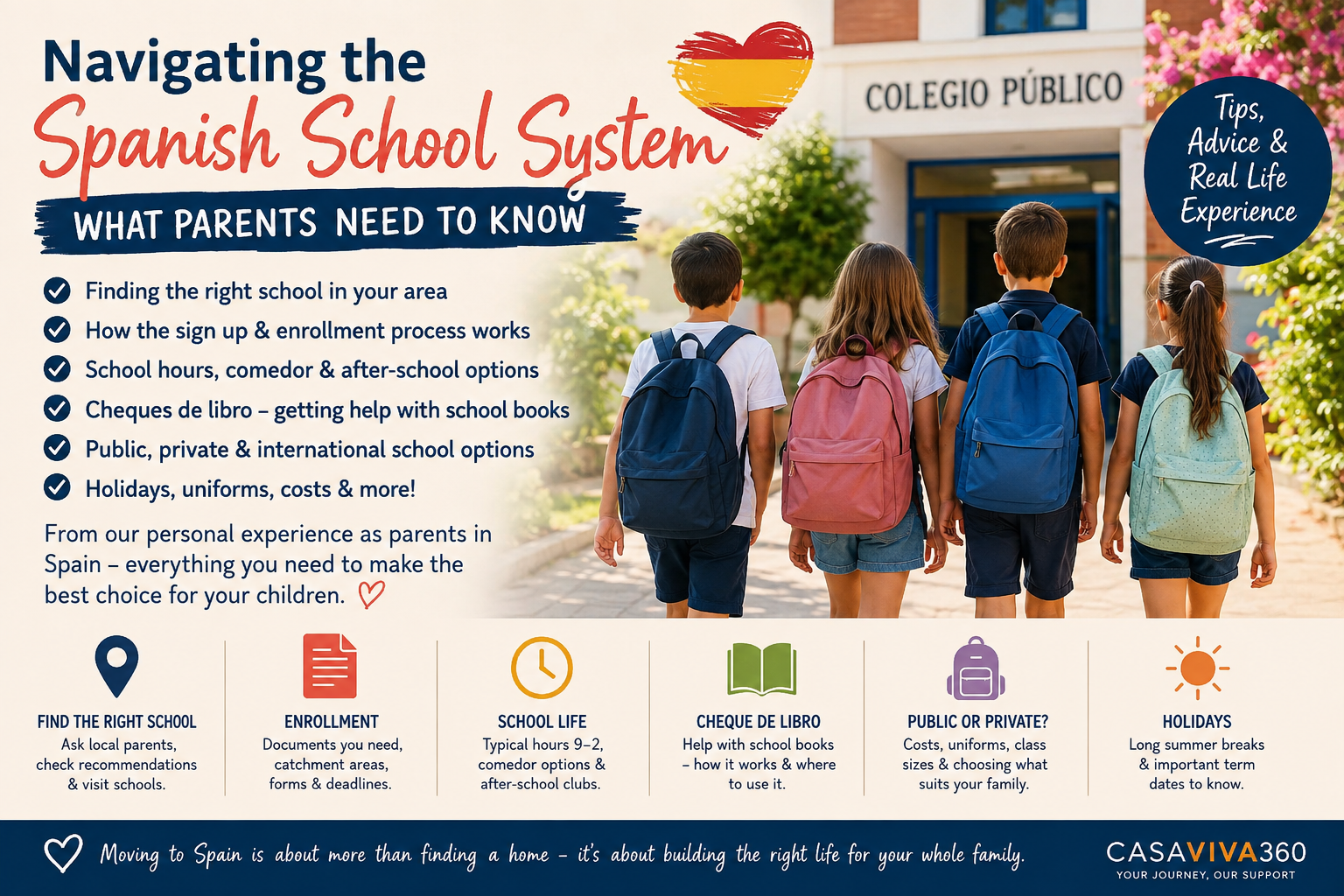
Moving to Spain with children?
One of the biggest questions I hear from families is:
"What is the school system actually like in Spain?"
And honestly, I completely understand why.
Moving your children to another country is a huge decision. You're not just choosing a house or a new area to live in — you're choosing where your children will spend a huge part of their childhood.
I've been through the Spanish education system with my own children, including Spanish state schools and high school, and now a Spanish part-private school.
So this isn't just something I've researched.
I've lived it as an English parent raising children in Spain.
And overall?
I genuinely think the Spanish education system is great.
But there are things I wish I'd known when we first started navigating it.
🇪🇸 First things first: finding the right school
My biggest piece of advice?
Don't choose your school based purely on what you find online.
If you're moving to a particular area, I'd join local Facebook groups and, particularly, local mums' groups.
Ask questions.
Ask:
- Which schools do you recommend?
- Which schools have the best reputation?
- How are the teachers?
- How good is communication with parents?
- How does the school support children who don't speak Spanish?
- What are the class sizes like?
- What is the comedor like?
- Are there good after-school activities?
- Have parents had good or bad experiences?
- Would you send your own child there?
You can learn so much from local parents.
And don't be afraid of hearing negative experiences either.
Sometimes a school that sounds fantastic online isn't the right fit for your child, while another school that doesn't have the fanciest website might have an amazing community and teachers.
Local parents can be your best source of information.
🏫 Spanish state schools
Spanish public schools are called colegios públicos for younger children and institutos for secondary education.
They are state-funded and don't have the same tuition fees as private schools.
One of the biggest differences you will notice as an English parent is that Spanish is the language of education in most state schools, although bilingual programmes and other language arrangements exist depending on the autonomous community.
And this brings me to something really important.
What age are your children?
If you have a young child, I wouldn't necessarily be frightened by the language barrier.
Children are incredible.
They adapt.
They make friends.
They pick up words from other children.
They hear Spanish all day.
And very often they start understanding far quicker than their parents expect.
In my experience, you need to give them time to settle.
I personally think allowing around six months for a child to properly find their feet can be a realistic expectation — although every child is different.
Some will adapt incredibly quickly.
Others will need much longer.
The important thing is not to panic after the first few weeks.
🇬🇧 What about older children who don't speak Spanish?
This is where I would think much more carefully.
If you're moving with a teenager who has very little or no Spanish, putting them straight into a Spanish secondary school can be a very different experience.
They're not simply learning Spanish.
They're trying to learn Spanish while simultaneously learning history, science, mathematics, geography and everything else in Spanish.
And they're doing it at an age when academic expectations are increasing.
For some teenagers, this can be incredibly difficult.
This is where an international or bilingual school may be worth considering.
It isn't because Spanish schools aren't good.
Quite the opposite.
It's because you need to consider where your child is academically and emotionally, as well as their language level.
A younger child may be able to absorb Spanish very quickly.
A 15-year-old arriving without Spanish may have a much harder road ahead.
For older children, I'd strongly recommend looking at the different options before you move.
📝 How does enrolling in a Spanish state school work?
This is one of the parts that can initially feel confusing.
School admissions are generally handled through the education authority of your autonomous community, and the exact process and dates vary depending on where you live.
Your child's place can depend on things such as:
- Where you live and your catchment area
- Available places
- Your child's age/year group
- The school's capacity
- And the admission criteria used by your autonomous community
You'll normally need documentation proving your identity, residence and your child's circumstances.
Depending on your situation, this can include things such as:
- Passport
- NIE/TIE documentation
- Padrón/empadronamiento
- Birth certificate or family documentation
- Previous school records
- Vaccination or medical documentation where required
- Proof of other circumstances relevant to the application
The exact documents vary, so always check with your local education authority or school.
My advice?
Don't leave this until the last minute.
If you know you're moving, start researching schools and the admissions process as early as possible.
And remember that being close to a school doesn't necessarily guarantee a place there.
Catchment and available places matter.
📚 What is the "cheque de libro"?
This was something I had to learn about when navigating school in Spain.
Spain has various programmes to help families with the cost of school books and educational materials.
However, there isn't one single nationwide "cheque de libro" system that works identically everywhere.
The exact programme, eligible school years, amount and application process depend on the autonomous community.
There is national funding supporting these regional schemes. For 2026, the Ministry of Education allocated €58.56 million to the autonomous communities for textbook and educational-material support, covering pupils in publicly funded schools across a range of educational stages. (Educação e Desporto)
In some areas, you'll hear parents talk about cheque-libro, while other communities use book-loan or textbook-reuse programmes.
If you're eligible and receive a book voucher, this is where your local papelería can become your best friend!
You take the voucher or authorised documentation to the participating stationery/book shop in your town, and they can arrange the books your child needs for their school year.
Always check the current scheme in your autonomous community, because the eligible years and process can change.
And honestly, it's one of those little Spanish systems that seems confusing at first — but once you've done it once, you wonder why you were ever worried!
🕘 What are Spanish school hours like?
A typical public-school day can be quite different from what some British parents are used to.
Many schools operate approximately around:
9:00am – 2:00pm
although exact hours vary by school and region.
And this is where the comedor can be incredibly useful.
🍽️ The comedor
The comedor is the school dining service.
Children can stay at school for lunch and supervised time during the middle of the day.
This can be a lifesaver for working parents.
In many schools you can apply for comedor places, and some families may need to provide documentation such as employment contracts or working hours to demonstrate their childcare needs.
Again, the exact criteria and subsidies vary by region and school.
But don't overlook it when you're looking at schools.
Ask about comedor availability before you accept a school place.
⚽ What about after-school clubs?
This is another difference I've noticed.
Some schools offer extracurricular activities, but the selection varies considerably.
You shouldn't assume that every school will have a huge list of after-school clubs.
Instead, look at your local polideportivo/deportivo.
Spanish towns often have excellent municipal sports facilities where children can take part in:
- ⚽ Football
- 🏊 Swimming
- 🏀 Basketball
- 🎾 Tennis
- 🥋 Martial arts
- 💃 Dance
- 🏐 Volleyball
and many other activities.
Personally, I think this is one of the great things about raising children in Spain.
Their social life doesn't necessarily revolve entirely around school.
They can become part of their local community through sport and activities.
☀️ The Spanish summer holidays
Prepare yourself for a very long summer!
Spanish schools generally finish around the end of June and return in September, with the exact dates varying by autonomous community and school.
A common return period is around the second week of September.
And honestly?
By the end of June, you'll understand why.
It gets HOT.
Classrooms can become extremely warm, particularly in areas of Spain where summer temperatures are high.
The long summer break also gives children a proper opportunity to enjoy the Spanish lifestyle:
- Pool days.
- Beach days.
- Family time.
- Late evenings.
- Village fiestas.
- Sport.
- And just being outside.
It's a very different rhythm to school life in the UK.
👕 Uniforms vs normal clothes
One thing parents often ask me about is school uniforms.
Spanish state schools
Generally, children don't wear school uniforms in Spanish public schools.
They wear normal everyday clothes.
This can be a nice change for families moving from the UK.
Private schools
Private schools commonly have uniforms, and these can be part of the school's identity.
You should factor the cost of uniforms into your budget when comparing private schools.
🏫 What about private and international schools?
Private education is another option, and Spain has a huge range of schools.
You'll find:
- Spanish private schools
- Bilingual schools
- International schools
- British schools
- American schools
- IB schools
- Spanish schools with international programmes
The biggest advantage for an international family can be the language support and continuity of education.
But there is a significant cost difference.
💶 How much does private school cost?
There isn't one standard price.
It depends enormously on the school, region, curriculum and services.
As a broad 2026 guide, private education in Spain is often around €400–€900 per month, although international and premium schools can exceed €1,500 per month. (Micole)
And remember that the monthly fee isn't necessarily the total cost.
You may also have:
- Registration fees
- Uniforms
- Books
- School meals
- Transport
- Extra-curricular activities
- Technology fees
- Trips
For example, current 2026 estimates put registration fees at roughly €500–€3,000 per year, uniforms around €200–€600, books around €300–€500, comedor around €100–€180 per month, and transport around €80–€250 per month, depending on the school. (Micole)
So when comparing schools, don't just ask:
"How much is the school per month?"
Ask:
"What is the total cost for the year?"
🇪🇸 My personal experience as an English parent
I've had children go through Spanish public schools and high school, and now we also have experience with a Spanish part-private school.
And honestly, I think the Spanish education system is fantastic.
But I also know that I'm an English parent.
And because of that, I have always been conscious of making sure my children don't fall behind academically, particularly where language is involved.
For us, that has meant prioritising:
- 📚 Homework
- 👩🏫 Extra tutoring when needed
- 🇬🇧 Maintaining their English
- 🇪🇸 Supporting their Spanish
- 📝 Making sure they understand what they're being taught rather than simply memorising it
I don't believe that means you need to sit over your child's homework every night or panic about their education.
It's simply about being aware that they're learning in another language and may need some additional support while they find their feet.
And I've seen how quickly children can progress.
My advice would always be:
Give them time, but keep an eye on their progress.
Don't panic if the first few months are difficult.
But don't ignore it if they're genuinely struggling either.
🏫 Our experience with a part-private school
We've now experienced a Spanish part-private school too, and one of the biggest differences for us has been the structure and longer school day.
Private and semi-private schools can have different timetables, but it's common to see days starting shortly before 9am and finishing around 4pm or 5pm, depending on the school and whether meals or activities are included.
For working parents, that can make a huge difference.
It also means you need to look beyond the headline school fee and understand exactly what you're paying for.
❤️ My advice to families moving to Spain with children
If you're moving with children, don't choose your Spanish home first and then think:
"Now let's find a school."
I'd actually do both at the same time.
Your school choice can influence:
- 📍 Where you live
- 🚗 Your daily driving
- 🏠 The type of property you need
- 👫 Your children's social life
- ⚽ Their activities
- 🕘 Your working hours
- 💶 Your monthly budget
And ultimately, your family's experience of living in Spain.
My checklist would be:
- Choose your area — Think about where you actually want to live.
- Join local parents' groups — Ask for honest recommendations.
- Make a shortlist — Look at public, concertado, private and international options where appropriate.
- Visit the schools — Don't make your decision entirely from a website.
- Consider your child's age — A five-year-old and a fifteen-year-old arriving without Spanish have very different needs.
- Check the admissions process — Find out the application dates, catchment arrangements and required documentation.
- Check comedor — Especially if both parents work.
- Look at extracurricular activities — And don't forget the local polideportivo.
- Calculate the real cost — Particularly with private schools.
- Give your children time — Moving country is enormous for a child.
Six months can feel like a long time to an adult, but for a child it can be the beginning of a completely new life.
🇪🇸 And finally…
One of the things I love most about raising children in Spain is watching them become part of two worlds.
They can learn Spanish.
They can experience Spanish culture.
They can make friends locally.
They can still keep their English language and connection to where they came from.
And eventually, you often find that your children are translating things for you!
Moving to Spain with children can feel overwhelming.
There will be paperwork.
There will be Spanish forms.
There will be school emails you have to translate.
There will be days where you wonder if you've made the right decision.
But there will also be school fiestas, summer evenings, new friendships, sports, Spanish traditions and watching your children grow up with an incredible mix of cultures.
That's the part I wouldn't change. ❤️
And that's exactly why I believe that moving to Spain should be about more than finding a property.
At CasaViva360, we're here to help you understand the bigger picture — from finding your home and understanding the buying process to relocation, schools, healthcare, taxes and everything in between.
Because when you're moving your family to another country, the house is only one piece of the puzzle.
You need to find the place that works for your whole family.
And that's what CasaViva360 is all about. 🇪🇸❤️
Please note: school admission procedures, catchment criteria, textbook assistance, comedor subsidies, school calendars and fees vary between autonomous communities and individual schools. Always check the current requirements with the relevant education authority and school before making decisions.
Get the latest Spain property insights
Market reports, area guides, and new articles — straight to your inbox.
